Mention COSHH to a small UK contractor and you often get a sigh. Lots of paperwork. Lots of forms. Lots of jargon.
The reality is that the Control of Substances Hazardous to Health Regulations 2002 (COSHH) is one of the most important pieces of UK health and safety law for the trades. Construction dust alone kills more workers each year than falls from height.
Here is a practical guide to getting COSHH right on small jobs.
What Counts as a Hazardous Substance?
Under COSHH, a hazardous substance is anything that could harm health. That includes:
- Chemicals (solvents, cleaning products, paints, resins, two-pack adhesives)
- Fumes and vapours (welding fumes, exhaust)
- Dust (silica from cutting concrete, wood dust, plaster dust)
- Mists (spray paint, oils)
- Gases (oxygen-deficient atmospheres, carbon monoxide)
- Biological agents (bacteria, mould, sewage)
It does not cover asbestos, lead or radioactive substances, which have their own regulations.
The 8 Steps of COSHH
The HSE breaks COSHH compliance down into 8 steps:
1. Assess the Risks
Identify the hazardous substances you use or create on site. Walk the job. Read the labels. Talk to your team.
2. Decide What Precautions Are Needed
Use the hierarchy of control:
- Eliminate the substance (use a different process)
- Substitute with something less harmful
- Use engineering controls (LEV, on-tool extraction, water suppression)
- Use organisational controls (limit exposure time, restrict access)
- Use PPE as a last resort
3. Prevent or Adequately Control Exposure
Make sure controls are in place before work starts. Half-fitted LEV or PPE in the van is not control.
4. Ensure Controls Are Used and Maintained
LEV must be tested and examined at least every 14 months. RPE must be face fit tested and stored properly. Filters must be replaced.
5. Monitor Exposure
For higher risk work (silica, welding fumes, isocyanates), you may need to monitor airborne concentrations.
6. Carry Out Health Surveillance
For specific substances and tasks, health surveillance is required. Examples include:
- Respiratory questionnaires for dusty work
- Skin checks for wet work and solvents
- Lung function tests for silica work
7. Prepare for Emergencies
What happens if there is a spill? A splash in the eyes? Inhalation of fumes? Plan it before it happens.
8. Inform, Instruct and Train
Every worker exposed to hazardous substances must understand the risks, the controls and what to do in an emergency.
Construction Dust: The Big One
The HSE estimates that more than 12,000 deaths each year in the UK are linked to past exposure to dust and chemicals at work.
The three main dust hazards in construction are:
1. Respirable Crystalline Silica
From cutting, grinding or drilling concrete, mortar, stone, brick or tiles.
The workplace exposure limit is just 0.1 mg/m3 over an 8 hour period. A few minutes of uncontrolled cutting can exceed that.
2. Wood Dust
Hardwood and softwood dust can cause asthma, lung disease and nasal cancer. Hardwood is a known carcinogen.
3. General Construction Dust
Mixed dust from demolition, refurb and cutting. Even where there is no silica, dust at high enough levels causes respiratory disease.
Controlling Dust
The HSE expects three approaches, in order:
1. Eliminate or Reduce
- Use pre-cut materials
- Use less dusty alternatives
- Plan to reduce cutting where possible
2. Water Suppression
- Wet cutting saws
- Water hose attachments
- Damp down dust before sweeping
3. On-Tool Extraction
- M-class or H-class vacuums attached to tools
- LEV on benches and saws
- HEPA filtration
RPE (typically FFP3 masks) should be the last line of defence, not the first.
COSHH Assessments for Small Jobs
You do not need a 50 page document for every job. A simple COSHH assessment should cover:
- The substance or activity
- Who is exposed and how
- The level of risk
- The controls in place
- The PPE and RPE required
- Emergency arrangements
Many small contractors maintain a library of generic assessments (one for each common substance or task) and select the relevant ones for each job.
Safety Data Sheets
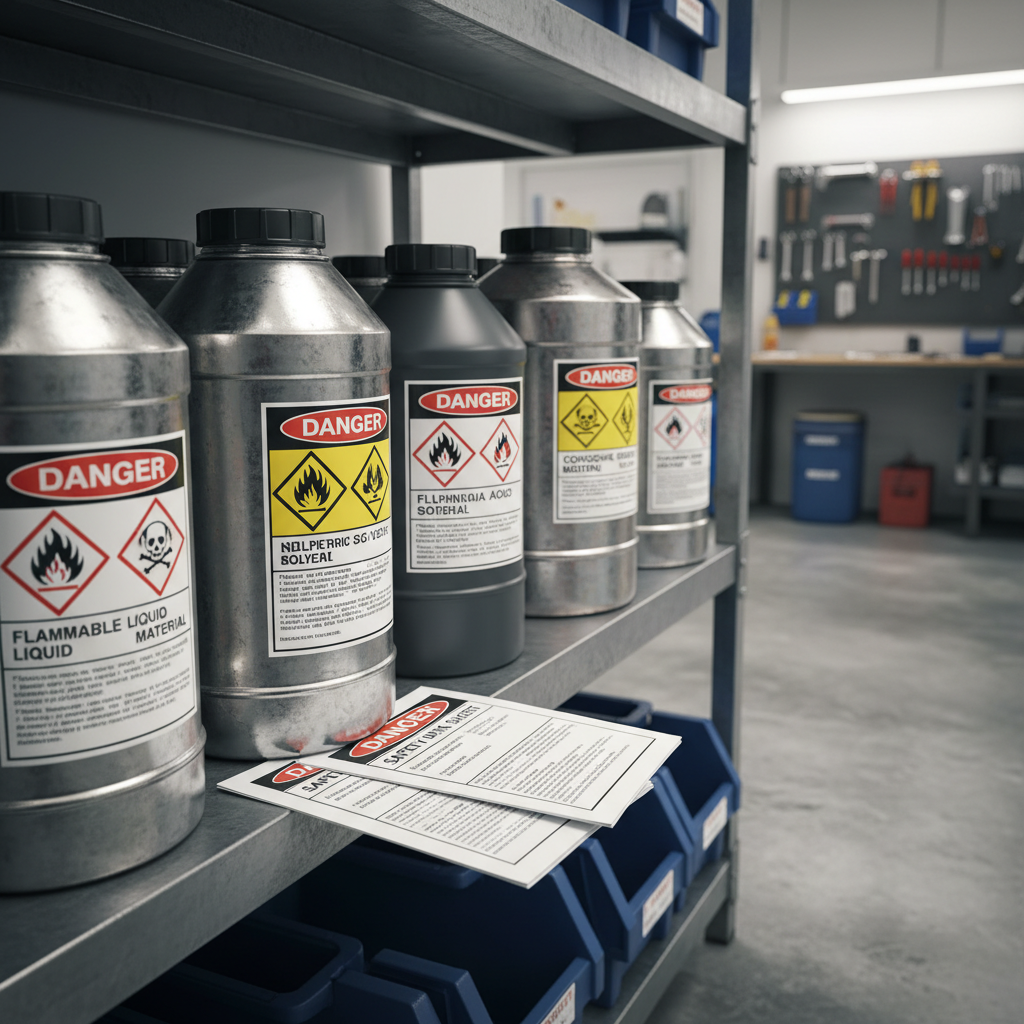
For every hazardous chemical you use, you should have a Safety Data Sheet (SDS) from the supplier. These cover:
- Hazards
- First aid measures
- Firefighting measures
- Spill procedures
- Handling and storage
- Exposure controls and PPE
- Toxicological information
Keep them in a folder on site or available digitally. They are essential reading when writing your COSHH assessment.
Common Mistakes
- No COSHH assessment because the job is small
- Relying on FFP3 masks alone with no extraction
- Dry sweeping dust at the end of the day
- Storing chemicals in unlabelled containers
- Mixing incompatible chemicals (bleach and ammonia, two-pack components)
- No emergency arrangements for spills or splashes
- No training records
Final Thoughts
COSHH does not have to be complicated. The key is to take it seriously and apply it consistently.
Identify your substances. Assess the risk. Control exposure using the hierarchy. Train your team. Keep simple records.
Do that, and you will protect your workers from one of the biggest hidden killers in UK construction, while keeping the HSE happy at the same time.