Year after year, falls from height are the single biggest cause of workplace fatalities in UK construction.
It is not always the high-profile jobs. Many of the fatal falls every year happen from ladders, low roofs, scaffolds and even step stools.
The Work at Height Regulations 2005 cover all of these, and they apply to every UK employer, contractor and self-employed person.
What Is Work at Height?
The definition is broader than most people realise.
Work at height is any work where, if precautions were not taken, a person could fall a distance liable to cause personal injury.
That includes:
- Working on a roof
- Working from a scaffold
- Working from a ladder or stepladder
- Working on a Mobile Elevating Work Platform (MEWP)
- Working near an open edge or excavation
- Working in a position where a fall through a fragile surface is possible
Ground level work next to an excavation, where a fall could happen, also counts.
The Hierarchy of Control
The Regulations set out a clear order of preference:
1. Avoid Work at Height
Do not work at height if you do not have to. Can the job be done from the ground? Telescopic poles, remote control tools and pre-fabrication can often eliminate the need to climb.
2. Prevent a Fall
If you must work at height, prevent a fall. Use guard rails, scaffolds, MEWPs with full edge protection, or working platforms.
3. Minimise the Distance and Consequences
Where a fall cannot be prevented, minimise the distance and the consequences. Nets, airbags and personal fall arrest systems are examples.
This hierarchy is not optional. The HSE will expect to see that you have considered each step in order before relying on the next.
Common Equipment in the Trades
Ladders
Ladders are still permitted, but they should only be used for short duration work (typically 30 minutes or less) and low risk tasks. They must be:
- The right type for the job (Class 1 industrial, EN 131 professional)
- In good condition
- Inspected before each use
- Tied or secured at the top, or footed for very short use
- On firm, level ground
Step Stools and Hop Ups
Fine for low level access, provided they are stable and used on level surfaces.
Scaffold Towers
Mobile aluminium scaffold towers must be:
- Erected, altered and dismantled by trained operatives (PASMA or equivalent)
- Used on firm, level ground
- Fully boarded with guard rails and toe boards
- Inspected before use and at least every seven days
Fixed Scaffolding
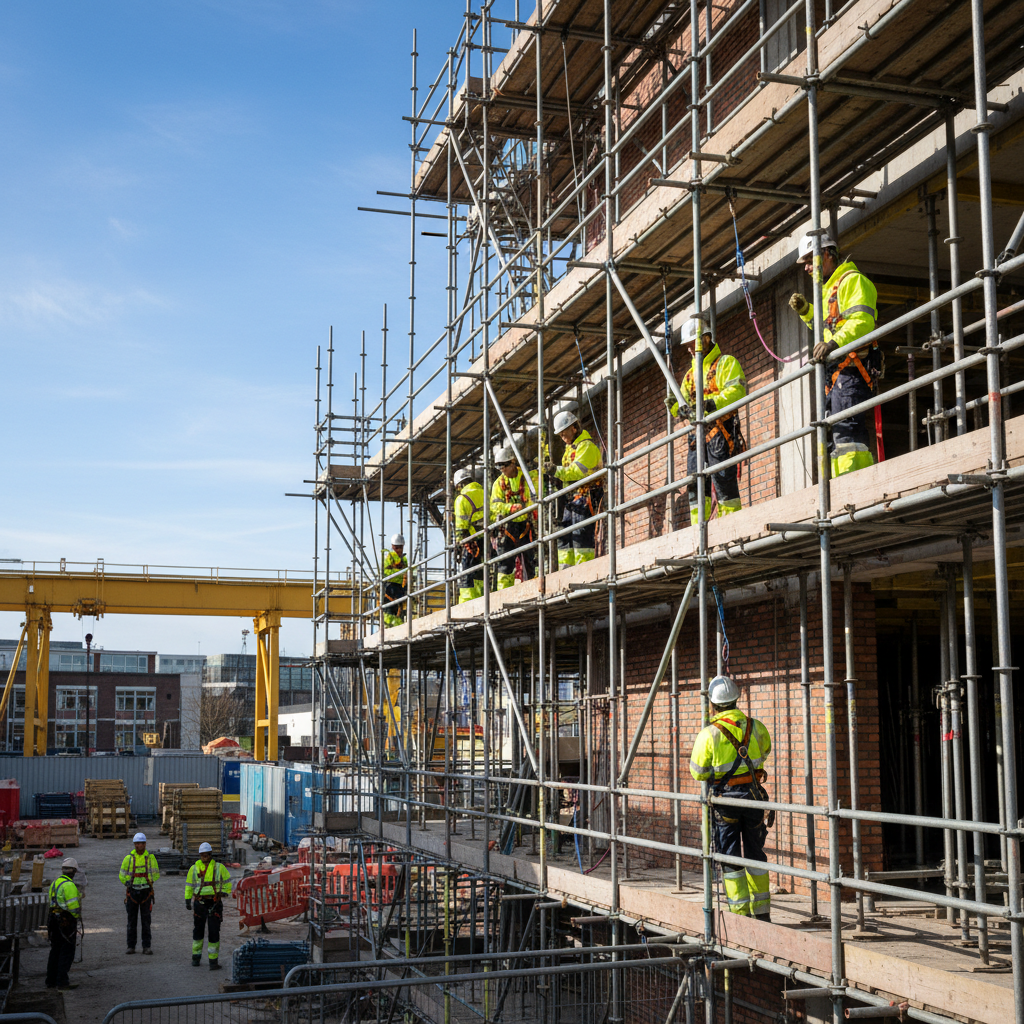
Must be erected and dismantled by competent persons under the supervision of a CISRS qualified scaffolder. Inspections required every seven days and after adverse weather.
MEWPs (Cherry Pickers and Scissor Lifts)
Operators must be IPAF trained. Pre-use checks are essential. A rescue plan must be in place in case the platform fails.
Roof Work
Fragile roofs cause many UK deaths every year. Always:
- Assume the roof is fragile until proven otherwise
- Use crawler boards, fall arrest nets or scaffolds
- Never walk on a roof without proper protection
Inspection and Records
Work at height equipment must be inspected before each use by the user.
In addition:
- Scaffolds must be inspected by a competent person before first use, at least every seven days, and after any event that may have affected stability
- Personal fall arrest equipment must be inspected at least every six months by a competent person
- MEWPs and other plant must be inspected and thoroughly examined in accordance with LOLER 1998
Keep written records of all formal inspections.
Training
Anyone working at height must be competent. For the most common equipment, recognised UK training providers include:
- PASMA (mobile towers)
- CISRS (scaffolding)
- IPAF (MEWPs)
- IRATA (rope access)
Document all training. Keep copies of certificates.
Emergency and Rescue
One of the most commonly overlooked areas is rescue.
If someone falls into a harness and is left suspended, suspension trauma can become life threatening in minutes. You cannot rely solely on calling 999.
Every work at height plan should include:
- How a casualty would be rescued
- Who would carry out the rescue
- What equipment is on site to do it
- How quickly it could be done
Domestic Work
The Work at Height Regulations apply to domestic builders, roofers, gutter cleaners and window cleaners just as much as they do to large contractors.
A single death on a domestic job will be investigated by the HSE in exactly the same way as on a commercial site.
Common Mistakes
- Using ladders for long duration work
- Standing on the top three rungs of a stepladder
- Working off scaffolds erected by untrained labour
- No edge protection on flat roofs
- Believing harnesses are enough on their own (they are not, without a suitable anchor and rescue plan)
- No method statement or risk assessment for short jobs
- Treating it as a one-off so deciding not to bother
Final Thoughts
Working at height is the single biggest killer in UK construction. It is also one of the most regulated.
Get your risk assessments and method statements right. Choose the right equipment. Train your operatives. Inspect everything. Plan for rescue.
The rules are not there to slow your work down. They are there to make sure everyone goes home at the end of the day.